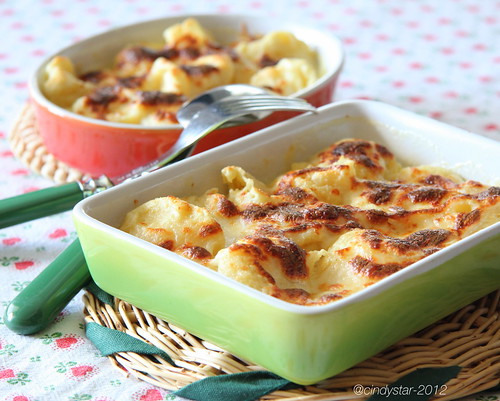
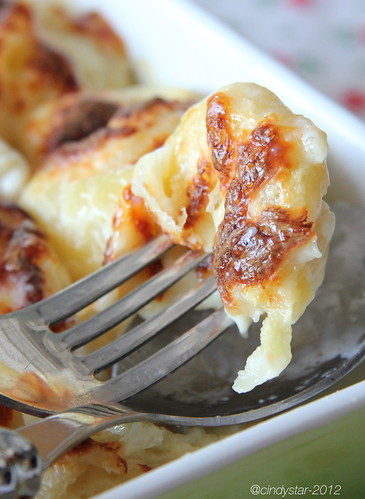
Visualizzazione post con etichetta valle d'aosta. Mostra tutti i post

25 aprile 2013

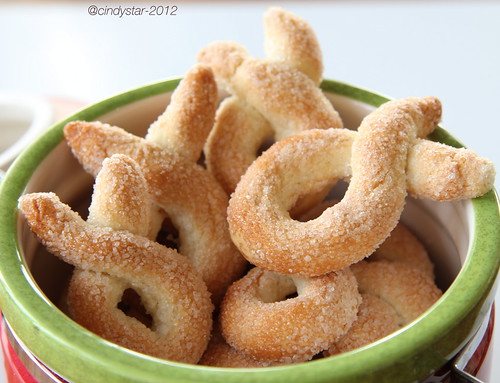
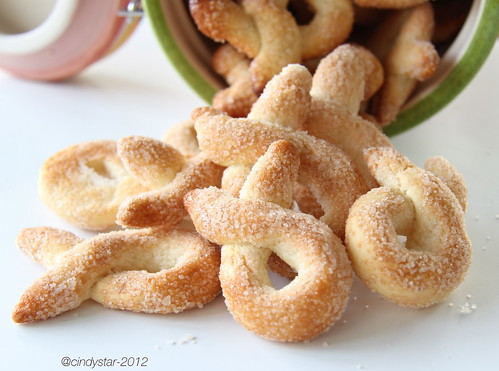
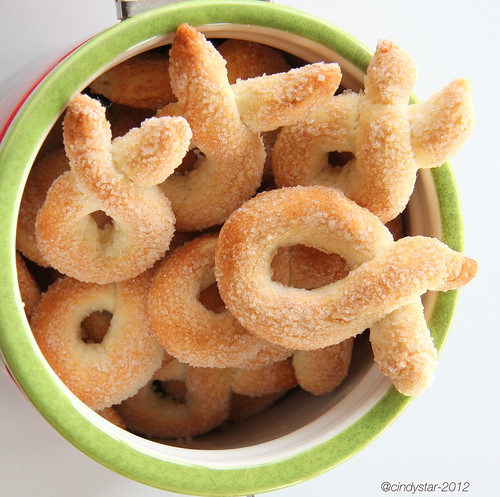
Torcettini di Saint Vincent - We Knead To Bake # 4


English recipe here

E siamo già al quarto appuntamento con  We Knead To Bake, il gruppo creato a inizio anno da  Aparna di My Diverse Kitchen, con la bella idea di cuocere ogni mese un pane diverso, in tutto 12 pani per tutto il 2013.
La ricetta di questo mese riguarda un impasto panoso reso però dolce da una leggera spolverata di zucchero che in forno cristallizerà formando una delicata glassa. Sto parlando dei famosi Torcettini di Saint Vincent.
Li avevo già fatti per l'Abbecedario Culinario d'Italia, in effetti le due ricette si assomigliano molto, solo in quella precedente si usa più burro.
Questi sono leggermente più secchi e croccanti, ma forse dipende anche dalla cottura del mio forno, probabilmente dovevo cuocerli qualche minuto in meno.
L'impasto però è molto più facilmente lavorabile ed è simpatica ed utile l'idea di tagliarlo in 24 piccoli riquadri con cui fare torcetti quasi perfetti ed uguali.
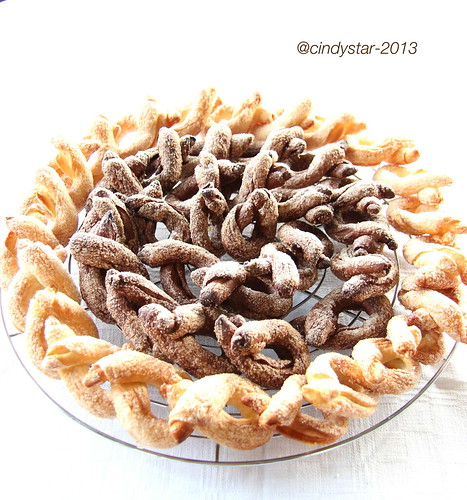
Ho fatto doppio impasto e metà li ho impastati col cacao, ma sinceramente preferisco la versione semplice tradizionale.
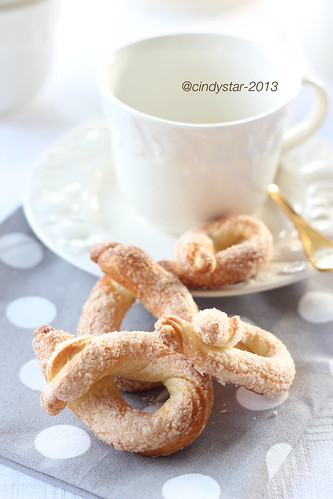
 torcetti st.vincent
Aparna ci racconta anche come pare siano nati questi biscottini, che delizieranno una merenda, un tè chiacchieroso fra amiche, un dopocena goloso: li avte mai provati con la crema di mascarpone? :-)

Pare che i torcettini abbiano origine dai grissini, infatti sono state fatti inizialmente con gli avanzi della pasta di pane. Secondo la leggenda, un fornaio che faceva spesso i grissini un giorno aveva del burro in più, che voleva utilizzare. LPreso dall'spirazione decise di aggiungere il burro all'ultimo impasto di grissini della giornata. Per essere sicuro di saper poi riconoscere i veri grissini da quelli burrosi, decise di fare rotolare questi ultimi rotolare nello zucchero e chiuderli a cerchio sormontato: nacquero così i Torcetti. Solitamente sono aromatizzati con scorza di limone o anice. Sembra anche che la regina Margherita, moglie di Umberto I di Savoia amasse così tanto biscotti che durante i suo soggiorni in Valle d'Aosta dava sempre ordini ai suoi servitori di cuocerne in abbondanza.
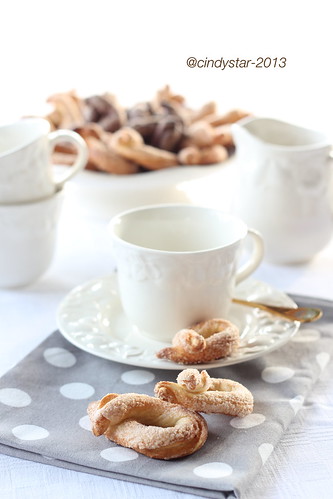
 torcetti st.vincent

Per 24 biscotti:
 100 g di acqua calda
8 g di lievito di birra
(o 1 cucchiaino di lievito secco istantaneo)
230 g di farina 0 *
1/4 di cucchiaino di sale fino
scorza di limone gratuggiata
(sostituire con la per la versione al cioccolato)
40 g di burro non salato, freddo e tagliato in piccoli pezzi
zucchero per rotolare i biscotti

* per la versione al cioccolato sostituire con:

190 g di farina 0
3 cucchiai rasi di cacao amaro
mezzo cucchiaino dicaffè in polvere
un cucchiao raso di zucchero a velo, facoltativo
scorza d'arancia invece che di limone


 torcetti st.vincent


Sciogliere il lievito in acqua tiepida, in una piccola ciotola e tenere da parte.

Mettete la farina (o farina+cacao+caffè) e il sale nella ciotola dell'impastatrice (o in una ciotola abbastanza grande se si impasta a mano) e dare un paio di impulsi per mescolare. Aggiungere i pezzi di burro e impastare a velocità bassa fino a quando il burro è ben amalgamato e il composto di farina-burro sembra polveroso (meglio usare la frusta a K).

Aggiungere lievito sciolto in lacqua e  impastare a velocità bassa fino a che l'impasto forma una palla. Non impastare ulteriormente. Mettere la palla di impasto in una ciotola oliata, girandolo bene che risulti oliato omogeneamente. Coprire la ciotola e lasciare lievitare.

Questo impasto in realtà non raddoppia di volume, ma dovrebbe sembrare gonfio dopo circa un'ora o giù di lì. Quando si pizzico fuori un po 'dalla cima è possibile vedere l'interno alla ricerca di un po' come a nido d'ape. Premere l'impasto verso il basso e sgonfiarlo, avvolgerlo nella pellicola e conservare in frigorifero per almeno un'ora, o fino a 24 ore.

 making torcetti
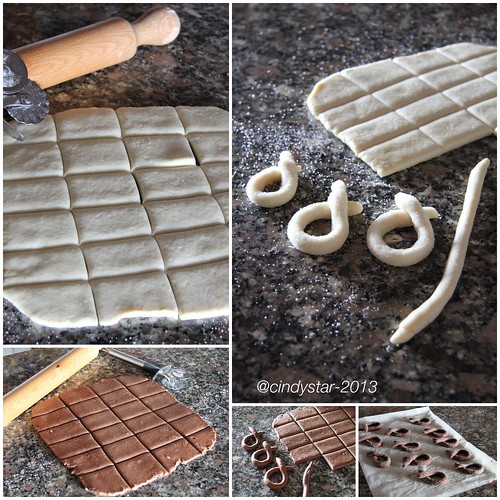
Stendere l'impasto in un quadrato di circa 18/20 cm di lato. Se la pasta fosse appiccicosa, spargere sopra un pochino di zucchero (e/o anche sul piano di lavoro). Con una rotella tagliare la pasta in quattro strisce di uguale larghezza. Tagliare poi ogni striscia in 6 pezzi uguali, in totale 24 pezzi. In questo modo sarà più facile avere torcettini quasi uguali, invece di pizzicare ogni volta la pasta con l'incognita di quanta se ne prende.
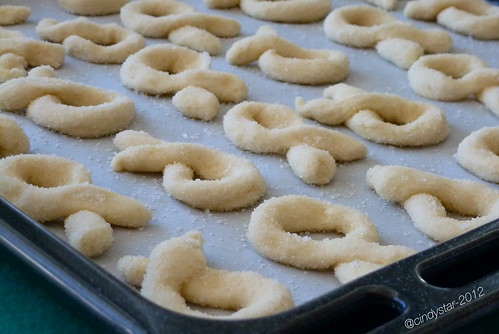
Arrotolare ogni pezzo  sul piano di lavoro fino ad una lunghezza di 15/18 cm. Rotolare il bigolo nella ciotola dello zucchero e chiuderlo a cerchio, sormontando le punte (come si fa con i taralli).

Appoggiare i torcettini sulla teglia rivestita di carta forno, lasciando spazio tra di loro. Lasciare riposare circa 20 minuti, devono solo leggermente gonfiare.

Cuocere a 160° per circa 25 minuti (ma potrebbero essere anche 20, controllarli dopo 15 minuti), finchè ben dorati. Raffreddare i biscotti completamente su una griglia. Conservarli in un contenitore ermetico a temperatura ambiente.
 torcetti st.vincent

24 aprile 2013

Sugar Crusted Twisted Cookies - Torcettini di St. Vincent - We Knead To Bake # 4


 la ricetta in italiano qui

Fourth appointment with We Knead To Bake, the baking group Aparna of My Diverse Kitchen created last January with the very nice idea to bake a different bread every month, 12 breads in all this year.
The choice for this month has gone surprisingly to something sweet and typically Italian, Torcettini di Saint Vincent, crispy sweet cookies from Valle d'Aosta, a mountain region (the smallest in Italy) at the very North, where the magnificent Monte Bianco (Mont Blanc in French, White Mount) proudly stoods with its 4,810 m (15,781 ft), the highest mountain in the Alps and the European Union. You can read some info about this region here.
Torcetti means twisted, and it's the characteristic shape of these cookies. 
They are very friable, greedy sugar crusted, pretty good-looking, ideal for an afternoon tea.


torcetti st.vincent


Aparna gently gives some words about the story of the cookies:
Torcetti/Torcettini are believed to have descended from Grissini (breadsticks) which were made from the leftover scraps of bread dough. According to one story, a Grissini baker had some leftover butter which he needed to use up. Inspiration struck and he decided to add the butter to the last batch of his Grissini dough for the day. To be able to differentiate this lot of “breadsticks” from his Grissini, he rolled them in sugar and shaped them into loops, and the Torcetti was born. Torcetti/Torchettini are usually flavoured with lime/lemon zest or anise. Apparently, Queen Margaret, the wife of King Umberto I of Savoy loved these biscuits so much during her stay in Valle d'Aosta, that she gave her servants enough provisions to bake an abundant supply for her consumption.


 torcetti st.vincent


I already baked Torcettini last year for the Culinary Italian ABC,  and the two recipes are similar, except mine has much more butter and I don't really know if it's and advantage or not: I remember that dough was quite troublesome to manage, pretty slippery if not kneaded for long. This of Aparna's is easy workable, the rest in the fridge is essential and helps a lot, and I appreciated the previous cutting of the dough in 24 equal small squares. But Aparna's Torcetti were a little too dry and crunchy, maybe a little more butter could have helped, or perhaps they should have been baked a little less in my oven.
Nevertheless, they were very good and quickly desappeared! :-)
I baked two batches, one plain and one with chocolate: definetely I prefer plain version.

Recipe adapted from A Baker’s Tour by Nick Malgieri.


For 24 biscuits:

1/2 cup warm water, about 110F
1 1/4 tsp active dry yeast 
(or 1 tsp instant yeast)
1 1/2 cups all-purpose flour
2 tbsp cocoa powder 
(if making chocolate torcettini)
1/4 tsp salt
1 tsp lime/ lemon zest 
(replace with orange zest for the chocolate version)
40gm unsalted butter, cold and cut into small pieces
about 1/3 cup sugar for rolling the cookies


torcetti st.vincent


Dissolve the yeast in the warm water, in a small bowl and keep aside.

Put the flour and the salt in the food processor bowl (or a largish regular bowl if kneading by hand) and pulse a couple of times to mix. Add the butter pieces and pulse until the butter is well mixed and the flour-butter mixture looks powdery.

If making chocolate Torcetti, remove 2 tbsp all-purpose flour and add the 2 tbsp unsweetened cocoa powder mentioned in the recipe. Don’t add the lemon zest/ anise. Use orange zest and maybe add 1/ 2 tsp instant coffee powder with the flour.

Add the yeast-water mixture and pulse till it all comes together as a ball. Do not over process or knead. Place the ball of dough in a oiled bowl, turning it so it is well coated with the oil. Cover the bowl, and let the dough rise quite a bit.

This dough does not really double in volume, but it should look “puffy” after about an hour or so. When you pinch off a bit from the top you can see the interior looking a bit like honeycomb. Press down the dough and deflate it, wrap it in cling film and refrigerate it for at least one hour or up to 24 hours.


making torcetti


When ready to make the cookies, take the dough out and lightly roll it out into an approximately 6” square. If the dough feels sticky, scatter a little sugar on it. Using a pizza wheel cut the dough into four strips of equal width. Cut each strip into 6 equal pieces, by cutting across, making a total of 24 pieces. The measurements are not very critical in this part because this just makes it easier to have 24 equal sized bits of dough, as compared to pinching of bits of the dough.

Roll each piece into a pencil thick “rope” about 5” long. Sprinkle a little sugar on your work surface and roll the “rope” in it so the sugar crusts the dough uniformly. Form the “rope” into a loop crossing it over before the ends.

Place the Torcettini on parchment lined baking sheets, leaving 1 1/2" between them. Leave them for about 20 minutes or so till they rise/ puff up slightly. Don’t worry, they will not “puff up” much.

Bake them at 160C (325F) for about 25 minutes till they’re a nice golden brown. Cool the cookies completely, on a rack. Store them in an air-tight container at room temperature. 


If making chocolate Torcettini, remove 2 tbsp all-purpose flour and add 2 tbsp unsweetened cocoa powder.  Also add 2 tbsp powdered sugar and replace the lemon zest with orange zest while making the dough.


 This recipe also goes to Susan's weekly YeastSpotting

28 febbraio 2012

Saint-Vincent Torcetti (twisted cookies)


 la ricetta in italiano qui

Very friable cookies, ideal for afternoon tea, with a pretty high dose of butter but without sugar in the dough. Very common in Valle d'Aosta, a small mountainous region in North-Western Italy.
If stored in an airtight box, these cookies will keep well for several months ... if you manage to resist for so long!


torcetti saint-vincent


For about 80 cookies:

  • 500 g all-purpose flour
  • 7 g dry yeast
  • 200 g very soft butter
  • warm water, about 300 g
  • granulated sugar
  • a pinch of salt
  • buttered and floured baking tray (or use parchement paper)  

torcetti saint-vincent

Dissolve yeast in warm water.
Put flour and salt in a large bowl, make a well in the center and gradually add the water with the yeast, and begin to knead.
Turn over the dough on work surface and continue kneading until dough is smooth and elastic, if necessary add a little more water (but don't use it all if the dough does not require it). Shape into a ball and place in a buttered bowl, cover with plastic wrap and let rise in warm place for an hour or until doubled.
Gently transfer  the dough onto the working surface and knead in the butter for about ten minutes, until well amalgamated, then let rest for another hour in the bowl as above.
I incorporated the butter by adding 50 g at a time and kneading until completely absorbed: stretch out the dough like a pizza, spread butter, roll up as to make a loaf and then knead. It takes a little patience, but eventually you will have a soft and quite manageable dough. And it is a super softening beauty mask for your hands :-).
Of course, helping with a stand mixer will save you a lot of work, but still knead for long. 
Work the dough quickly, then take a little piece of dough and roll into a thin stick about 4 or 5 inches long, dip in sugar and then shape into oval bagel, joining the ends (I made a mistake and crossed over the two, but you should do as for taralli). 

 facendo torcetti saint vincent

Place cookies onto the baking tray (buttered and floured or lined up with parchement paper) and bake at 200° for about 10/15 minutes, depending on size, until  nice golden. Remove from oven and let cool before serving.
I had some burnt cookies on the bottom, because the sugar caramelized too much (I was using a new oven and still not much confident with it :-): do not worry, once cool just gently grate on a cheese grater (suitably clean and odorless :-), they will get as perfectly baked!

 torcetti saint-vincent


Some information about Valle d'Aosta from Wikipedia:

It is a small mountainous region in North-Western Italy, bordered by Rhône-Alpes, France to the west, Valais, Switzerland to the north and the region of Piedmont to the south and east.
It is the smallest, least populous, and least densely populated region of Italy.
The native population speaks Valdôtain, a form of Franco-Provençal (Arpitan), as their first language, while in the Lys Valley there is a Walser German speaking minority. The regional capital is Aosta.
The cuisine of the Aosta Valley is characterized by simplicity and revolves around "robust" ingredients such as potatoes, polenta, and rice, cheese and meat and rye bread. Many of the dishes involve Fontina, a cheese with PDO status, made from cow's milk that originates from the valley. It is found in dishes such as a soup a la valpellinentse. Other typical local cheese are Toma and Robiola. Valle d'Aosta Fromadzo is produced locally since the 15th century and also has PDO status.
Regional specialties, besides Fontina, are mochetta (dried chamois meat, prepared like prosciutto), Vallée d'Aoste Lard d'Arnad (a cured and brined fatback product with PDO designation), Vallée d’Aoste Jambon de Bosses (a kind of ham, likewise with PDO designation), and a black bread. Notable wines include a white wine from Morgex, a red wine blend from Arvier (Enfer d'Arvier), and a Gamay.
Notable dishes include Carbonada, consisting of salt-cured beef cooked with onions and red wine served with polenta; breaded veal cutlets called costolette;tetouns, salt-cured cow's udder that is cooked and sliced; and bistecca a la valdostana, a steak with croutons and melted cheese.

 This recipe is also my entry to this week Susan's YeastSpotting.

25 febbraio 2012

Chnéf-fléne Walser per l'Abbecedario Culinario e WHB # 322


E' la volta di una ricettina salata per la Valle d'Aosta, la prima regione, capitanata dalla simpatica Gata da plar, ad inaugurare il nuovo Abbecedario Culinario organizzato dall'intraprendente  Trattoria MuVarA.
Per chi avesse voglia di partecipare con una ricetta valdostana, c'è tempo ancora fino a domani alla mezzanotte, per ogni ulteriore info sul regolamento vi rimando all'annuncio personale di Gata.
Ricettina dal titolo strano, ma dagli ingredienti semplici e di casa e di facile esecuzione.
Gli Chnéf-fléne (sinonimo dialettale per bottoni) altro non sono che degli gnocchetti fatti di latte, farina e uova, poi conditi con burro fuso o fonduta di Fontina. E' una specialità della popolazione Walser, di origini germaniche, che si stabilì in Valle d'Aosta ancora in epoca medioevale.
Altre dettagliate informazioni sulla cucina valdostana e sulla storia di questa regione qui.

chnéf-fléne walser-whb 322


Per 3/4 persone:
  • 250/300 g di farina
  • 250/300 ml di latte
  • 1 uovo
  • sale
 cuocendo chnéf-fléne walser  chnéf-fléne walser nel burro fuso

Mescolare le uova con la farina e il latte, aggiungere un pizzico di sale ed amalgamare bene fino ad ottenere una pastella omogenea. Fare riposare per 30 minuti. 
Mettere a bollire abbondante acqua salata e con l'aiuto di un cucchiaio colare piccole quantità di pastella. Quando le palline che si formano riemergono in superficie, scolarle e disporle in una pirofila leggermente imburrata. Condire con burro fuso in cui è stata fatta appassire una cipolla e parmigiano oppure con fonduta di fontina e far gratinare in forno qualche minuto sotto al grill.
Per fare la fonduta: mettere ad ammorbidire la fontina a pezzettini nel latte per un paio di ore, poi sciogliere il tutto a fuoco dolce finchè ben cremoso, a piacere aggiungere un tuorlo d'uovo. Anche se la fonduta tende a rapprendersi in fretta poi in forno si riscioglierà e gratinerà bene.

chnéf-fléne walser


Chnéf-fléne Walser


Chnéf-fléne (literally buttons), are a sort of gnocchi, little dumplings made with a mix of flour, milk and eggs,  typically served with melted butter or cheese fondue.
They are a speciality of a Northern Italian region, Valle d'Aosta. 


chnéf-fléne walser

Serving 3/4:
  • 250/300 g all-purpose flour
  • 250/300 ml milk
  • 1 egg
  • salt

cuocendo chnéf-fléne walser   chnéf-fléne walser nel burro fuso

Mix eggs with flour, milk and a pinch of salt up to a homogenous batter. Let rest for 30 minutes. 
Take to a boil abundant salted water and helping with a spoon pour into small amounts of batter. When the dough balls come up to the surface, drain and lay on a baking dish, lightly buttered. Drizzle with melted butter (but first fry/sautée a little diced onion in it) and grated parmesan or with some cheese fondue and grill in the oven a few minutes.
For the fondue: let soak diced cheese (better if you use Fontina or something similar) in some milk for a couple of hours, then melt it all on low heat until very creamy, then add an egg yolk at your pleasure. Don't bother if the fondue will thicken quickly, just spread over the dumplings (with the liquid too) and it will melt again and perfectly bake in the oven.

 chnéf-fléne walser


Some information about Valle d'Aosta from Wikipedia:

It is a small mountainous region in North-Western Italy, bordered by Rhône-Alpes, France to the west, Valais, Switzerland to the north and the region of Piedmont to the south and east.
It is the smallest, least populous, and least densely populated region of Italy.
The native population speaks Valdôtain, a form of Franco-Provençal (Arpitan), as their first language, while in the Lys Valley there is a Walser German speaking minority. The regional capital is Aosta.
The cuisine of the Aosta Valley is characterized by simplicity and revolves around "robust" ingredients such as potatoes, polenta, and rice, cheese and meat and rye bread. Many of the dishes involve Fontina, a cheese with PDO status, made from cow's milk that originates from the valley. It is found in dishes such as a soup a la valpellinentse. Other typical local cheese are Toma and Robiola. Valle d'Aosta Fromadzo is produced locally since the 15th century and also has PDO status.
Regional specialties, besides Fontina, are mochetta (dried chamois meat, prepared like prosciutto), Vallée d'Aoste Lard d'Arnad (a cured and brined fatback product with PDO designation), Vallée d’Aoste Jambon de Bosses (a kind of ham, likewise with PDO designation), and a black bread. Notable wines include a white wine from Morgex, a red wine blend from Arvier (Enfer d'Arvier), and a Gamay.
Notable dishes include Carbonada, consisting of salt-cured beef cooked with onions and red wine served with polenta; breaded veal cutlets called costolette; tetouns, salt-cured cow's udder that is cooked and sliced; and bistecca a la valdostana, a steak with croutons and melted cheese.


every week

This recipe is my personal entry to WHB # 322
hosted by Aitina, Branka and Conchita from Fragoliva.
Thanks again to Haalo who manages greatfully all events,
Thanks again to Kalyn for her successfull idea!

Template Design | Elque 2007