Visualizzazione post con etichetta germania. Mostra tutti i post

27 aprile 2020

Spätzle tricolore e con spezzatino di cervo


 scroll down for English version

Ritorno al blog, non mi sono persa per strada. E dalla cucina non mi sono mai mossa, praticamente. E' la pigrizia nello scrivere che devo vincere, nonostante le innumerevoli promesse che mi sono fatta e rifatta... e che ancora spero di mantenere, nonostante pecchi ancora di puntualità negli appuntamenti presi. 
Oggi per voi la raccolta del Club del 27, la rubrica mensile dell'MTChallenge che ripropone vecchie sfide o rubriche come il Tema del Mese per riprovare ricette perse e rinfrescare la memoria di quanto fatto e cucinato dalla sua operosa e inarrestabile Community.
Il mese scorso il Club del 27 ha spento già la sua terza candelina ma sembra di ieri l'annuncio di Alessandra con questa nuova diavoleria in casa MTC.
Questo mese la scelta è ricaduta sullo speciale Gnocchi e l'omonima sfidadalla quale è nato il libro Facciamo gli gnocchi (in vendita online e nelle migliori librerie) e fra le tante ricette proposte ho scelto i simpatici Spätzle, pubblicati a suo tempo da Manuela.

Gli Spätzle sono piccoli gnocchetti di forma irregolare, originari dei paesi germanici e popolari anche nelle nostre zone alpine orientali. In Germania vengono serviti come contorno a piatti di cacciagione e carni ricche di intingolo; noi, invece, li abbiamo rivalutati come un primo gustoso, conditi semplicemente anche solo con burro fuso.
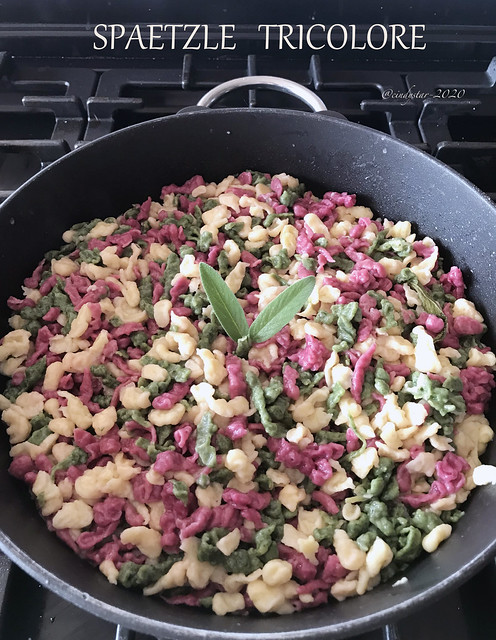

spätzle tricolore


Per 4 persone:
250 g di farina 0
3 uova
100 ml di acqua
un pizzico di noce moscata
un pizzico di sale

Per gli spätzle verdi o rossi:
80 g di spinaci lessati e frullati
(oppure una rapa rossa lessata e grattugiata fine)
125 g di farina
1 uovo
50 ml di acqua
un pizzico di noce moscata
un pizzico di sale
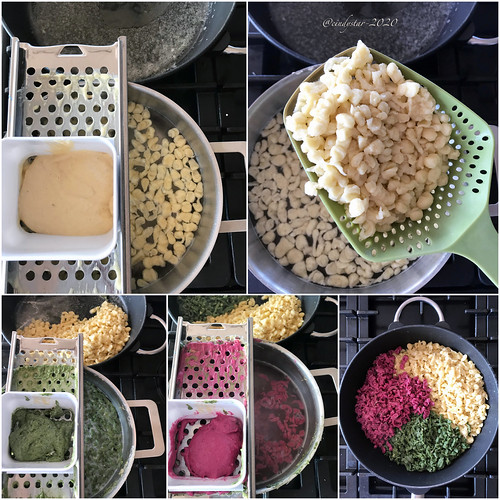

In una ciotola mescolare la farina col sale e la noce moscata.
In un'altra amalgamare l’acqua con le uova, unendo le verdure se si fanno verdi o rossi. Se le verdure fossero troppo acquose, ripassarle velocemente in padella per asciugarle e lasciarle poi raffreddare.
Versare i liquidi sulla farina e lavorare l’impasto con una forchetta finchè appaiono delle bolle. La pastella deve risultare densa e collosa, sollevandola con un cucchiaio di legno ricadrà a grosse gocce.
Coprire e far riposare in frigorifero per almeno 10-15 minuti.
Su una pentola di acqua salata in ebollizione posizionare la grattugia per formare gli spätzle (spätzlepresse), trasferire un po' di impasto nell'apposito contenitore e spostarlo avanti indietro in modo che l'impasto cada nell'acqua. Scolarli appena vengono a galla (o dopo pochi secondi) e adagiarli in una padella con burro fuso o olio.

facendo spätzle


Se si decide di farli tricolore, consiglio di iniziare a cucere prima i bianchi, poi i verdi ed infine i rossi, che sono quelli che sporcano irrimediabilmente l'acqua di cottura.
In mancanza della pressa per spätzle, si possono usare due spatole e seguire i movimenti spiegati in questo video oppure seguire i consigli della mia amica ungherese Susy in questo video (li fanno anche in Ungheria e si chiamano galuska).
Gli spätzle bianchi si possono aromatizzare in fase di impasto con un trito di aromatiche preferite: erba cipollina, origano fresco, maggiorana, basilico.
Condirli poi a piacere: burro fuso e Parmigiano/Pecorino a volontà, speck a listarelle o bacon croccante e panna, burro fuso e semi di papavero, una leggera fonduta di formaggio. Oppure servirli come accompagnamento a un gustoso spezzatino o Goulash.


Spätzle con Spezzatino di Cervo


spätzle con spezzatino cervo


In questo lungo periodo di quarantena ho passato, come tante persone, molto più tempo in cucina, essendoci impegnata  anche a mezzogiorno, cosa solitamente rara perchè in condizioni normali tutti lavorano e spesso e volentieri sono sola. A onor del vero sarei anche abbastanza stufa, un doppio lavoro a cui, almeno nei giorni feriali, non ero più abituata :-))
Fantasia portami via... e si provano nuove ricette o... si usano finalmente quelle cose (quasi) dimenticate nel freezer che languidamente giacciono al freddo e timidamente chiedono un riscatto doveroso e succulento. Ed è così per un nobile pezzo di cervo (a onor del vero meravigliose fette di polpa, la sorpresa è arrivata con lo scongelamento), regalo inaspettato di una speciale amica romagnola in uno dei nostri incontri (e non chiedetemi quale perchè ormai è perso nella memoria... quale memoria? :-)), prontamente trasformato in un succulento spezzatino e accompagnato egregiamente da graziosi immancabili Spätzle, in puro stile nordico.

Ho messo a marinare le fette di cervo in vino rosso (una Corvina in purezza, se non ricordo male, tipico della Valpolicella), con foglie di alloro, chiodi di garofano, scalogno, carota e sedano, bacche di ginepro, un pezzetto di cannella, grani di pepe di Sichuan, per un giorno intero, ben coperto e in frigorifero. Poi scolato e tamponato con carta cucina.
Nella mia adorata e onnipresente pentola a pressione vintage in alluminio ho fatto brasare un trito di cipolla, sedano e carota. Aggiunto poi il cervo (tagliando le fette a pezzetti), fatto rosolare, sfumato con Corvina fresca, unito un paio di cucchiai di passata di pomodoro (poca) e allungato con brodo vegetale. Coperchio, e dal fischio lasciato cuocere per quasi un'ora e mezza/due. Lo so, sembra un assurdo con la pentola a pressione ma volevo proprio che la carne si sfaldasse e risultasse super morbida. Come infatti fu.
Servito con gli Spätzle bianchi, aromatizzati con erba cipollina nell'impasto, conditi con burro fuso.


Tutte le ricette preparate questo mese qui.


Spätzle

 Serving 4:
250 g plain flour
3 eggs
100 ml water
a pinch of grated nutmeg
a pinch of salt

Green or red Spätzle:
80 g boiled and blended spinach
(or a boiled and blended red turnip)
125 g plain flour
1 egg
50 ml water
a pinch of grated nutmeg
a pinch of salt


In a bowl mix the flour with salt and nutmeg.
In another bowl mix the water with the eggs, adding the vegetables if you decide to make them green or red. If the vegetables are too watery, quickly sauté them in a pan to dry and then let cool.
Pour the liquids on the flour and knead the dough with a fork until bubbles appear. The batter must be thick and sticky, lifting it with a wooden spoon will drop in large drops.
Cover and leave to rest in the refrigerator for at least 10-15 minutes.
On a boiling pan of salted water, place the grater to form the spätzle (spätzlepresse), transfer some dough into the special container and move it forward backwards so that the dough falls into the water. Drain Spätzle as soon as they come to the surface (or after a few seconds) and place them in a pan with melted butter or oil. Sauté with some Parmesan and serve. You can add some fried bacon or speck or prosciutto if you like.

If you decide to make them in different colors, I recommend starting with the neutral, then the greens and finally the reds, which are the ones that irreparably get the cooking water dirty.
The yellow spätzle can be flavored with a mixture of your favorite aromatic herbs: chives, fresh oregano, marjoram, basil. 
Season the spätzle as you like: melted butter and Parmesan or Pecorino cheese at pleasure, speck strips or crispy bacon and cream, melted butter and poppy seeds, a light cheese fondue. They can also be served with a stew like Goulash.

24 marzo 2015

Kummelweck (Kimmelweck) Rolls - Panini al cumino


A simple and easy recipe this month for We Knead to Bake's challenge: Kimmelweck Rolls, soft buns with coarse sea salt or fleur de sel and caraway seeds on the top. Ideal for sandwiches and even burgers, though we just had them as normal bread.
They are German in origin as Kummel means caraway seeds while Weck means roll. In Buffalo in New York, these rolls are used to make a speciality sandwich called the Beef on Weck, with thinly sliced rare roast beef and horseradish and it is typically served with fries and a dill pickle.
Aparna suggests also a couple more recipes you can make with this dough, shown below.
You can fid a very helpful video here.
I made some buns with special sesame seeds I bought last winter at Salone del Gusto e Terra Madre in Turin. They are red becaus e flavored with Umeboshi, you can see the picture at the bottom of this post.


Ingredients:

2 1/2 tsp active dry yeast
1/2 cup warm water
1/2 cup warm milk
2 tbsp oil
1 tbsp honey
1 egg white (optional)
1 1/2 tsp salt
3 to 3 1/4 cups bread flour
egg wash (optional)
coarse sea salt and caraway seeds


Mix together the warm water and the warm milk and stir in the yeast. Let it sit aside for about 5 minutes. Knead by hand or with the machine.

In the bowl of your machine, combine the yeast mixture, oil, honey, the egg white and stir.Now add the salt and about 2 1/2 cups of flour and knead, adding as much more flour as required till you have a smooth and elastic  dough that is tacky but not sticky. Shape the dough into a ball, and place it in an oiled bowl. Cover loosely with cling film and let rise for about an hour, until it is almost double in volume.

Deflate the dough well (not kneading), shape into a round and and allow it to rise, covered, for 30 minutes more.
Divide the dough into 8 equal pieces and shape each into a smooth ball, then slightly flatten it. Place them on lightly greased or parchment lined baking sheets. Spray or lightly brush with oil, loosely cover and let the dough rise for 30 more minutes. Brush with eggwash (or something else that will make sure the topping sticks when baking), then cut slits ( like an +) on the top using a sharp blade or scissors.
Sprinkle the top of the rolls with sea salt and caraway seeds, and then mist with water. Bake the rolls at 220C (425F) for 5 minutes and then quickly mist with water again making sure you don’t keep the oven door open for too long.
Bake for another 20 minutes or so until they’re brown and done. Cool on a wire rack. This recipe makes 8 large burger bun sized rolls.

For the Vienna Loaf:

Follow the above recipe but with the following changes:
after the second rise, divide the dough in half and shape each half into an oval with tapered ends. After the final rise, apply the egg wash and then slash the top with a 1/2" deep lengthwise slit. Leave out the salt and caraway seeds.  Bake at 200C (400F) for about 35 minutes, including the 5 minutes after spritzing with water.


For the Salt and Pepper Sticks:

Again follow the above recipe for the rolls, but make the following changes :
leave out the second rise and do only the first rise. After that, divide the dough into 13 equal pieces. Roll each piece out into a 12" rope of even thickness, and place them  1-1/2" apart on the greased or lined bakng sheet. Let them rise now. Apply the egg wash, but do not make any cuts. Sprinkle with coarse sea salt crystals and coarsely ground or cracked black pepper. Do not spritz with water and bake for about 15 to 20 minutes.


This recipe also goes to Susan's weekly YeastSpotting.

29 dicembre 2013

Ricette teutoniche per l'Abbecedario Culinario


In questi giorni di festa l'Abbecedario della Comunità Europea ha proseguito il suo viaggio, fermandosi in Germania ospitati da Simona di Briciole.
Sono stata parecchie volte a Monaco di Baviera, città che amo molto e di cui conservo ricordi piacevoli di giornate e feste spensierate con amici italo/tedeschi.
Ho anche attraversato tutta la Germania, da nord a sud, in macchina nel 2006, ma entrambe le volte era notte e buio, e del porto di Rostock ho solo il ricordo di un grande e solitario imbarcadero, alle 4 di mattina erano ben pochi ad imbarcarsi per la Danimarca! Ma il traghetto era molto luminoso, funzionale e ben equipaggiato; ricordo con disappunto, però, la possibilità di fumare a bordo (forse ora si sono adeguati).
Non ho avuto la possibilità di cucinare nuove ricette per questa tappa, il susseguirsi di pranzi e cene di questo mese super festivo mi ha fatto concentrare su altre cose.
Ma consultando il blog, ho ripescato vecchie ricette ed altre più recenti che ci fanno comunque assaggiare qualcosa di originale teutonico.


 Bretzel

Un pane sfizioso e così caratteristico nella sua forma, presente ad ogni fiera e sagra, sempre in prima fila sul banco dei panettieri. Qui in ambedue le versioni,  croccante epiù soffice, per accontentare tutti davvero!


crunchy pretzels


Insalata di cavolo cappuccio


Un contorno semplicissimo, che mi piace molto, e che anche nelle nostre regioni Altoatesine non manca mai nei ristoranti e nei buffet degli alberghi, un classico evergreen! Perfetto con i bretzel di cui sopra.


 Gulasch


La cucina altoatesina risente molto dell'influenza austro/germanica e conseguentemente anche di quella ungherese per certe preparazioni, come il Gulasch. Infatti il suo nome completo in ungherese è  Gulyás-leves, che letteralmente significa "zuppa del mandriano", infatti questi ultimi erano soliti cuocere questo spezzatino (ma in origine era più brodoso, quasi una zuoppa) di manzo in un grande paiolo posto sopra ad un grande fuoco di legna all'aperto.
Ingredienti principali, oltre a della buona carne, sono le cipolle, in quantità quasi esagerata (vado sempre ad occhio, ma per avere un'idea per un pezzo da kilo di carne ho usato 5 o 6 cipolle dorate di grandezza media), e la paprika, sia dolce che piccante (poi ognuno modererà le quantità in base al gusto personale), spezia che uso spesso, ottenuta dalla macinazione del peperone fatto seccare precedentemente.
Questa è una ricetta di casa, così lo faceva la mia mamma, imparata da amici italo/bavaresi di famiglia coi quali per un lungo periodo abbiamo instaurato una sorta di gemellaggio amichevole e culinario.


Kugelhopf salato 


Versione salata del tradizionale dolce Kugelhopf, una torta lievitata molto popolare in Germania, Alsazia, Svizzera e Austria.
Perché questa torta si chiama Kugelhopf? Non ci sono certezze,  si ipotizza che il nome derivi dalla parola tedesca Kugel (palla) facendo riferimento alla sua forma rotonda, e Hopfen che significa alzare verso l'alto o sollevarsi sotto l'influenza del lievito. Oppure che derivi dalla parola alsaziana (tedesca) Gugelhut/Gugehüet, che si riferisce a una sorta di cappello medievale rotondo indossato dai membri del Senato di Strasburgo che governavano la città.


savoury kugelhopf


Rumtopf


I tedeschi e gli austriaci lo chiamano Rumtopf, il grande Pellegrino Artusi la chiamava frutta in guazzo: è un modo simpatico e per niente difficile per conservare la frutta, zuccherata e macerata nel rum secondo il metodo tedesco, nel bourbon come da tradizione francese, o anche nel brandy o altro preparato liquoroso ad almeno 40% di gradazione alcolica.
Usando il rum l'ideale sarebbe il Pott 54%, ma qua in Italia è molto difficile da trovare per cui ci si può benissimo arrangiare con un buon rum di qualità e rigorosamente scuro.
Si inizia a primavera inoltrata con le fragole, proseguendo poi durante tutta l'estate aggiungendo i vari tipi di frutta mano a mano che maturano. 


Strauben

E per finire un dolce, un dolce fritto tipico dell'Alto Adige, dell'Austria e della Bavaria.
Straub significa tortuoso, arricciato, e infatti la caratteristica forma è piuttosto contorta. E' un dolce tipico da sagra, viene sempre preparato nelle piazze dei paesi in occasione di feste popolari.
La sua versione più tipica è con una spolverata di zucchero a velo e accompagnato dalla classica marmellata di mirtilli rossi.


Queste ricette partecipano alla tappa in Germania per l'Abbecedario della Comunità Europea, ospitata da Simona di Briciole.


Auf Wiedersehen!

24 agosto 2013

Crunchy Hard Pretzels for We Knead to Bake # 8


Another great challenge for We Knead to Bake, the baking group of Aparna of My Diverse Kitchen, created with the intent to bake a different bread every month in 2013. 
I made soft Pretzel time ago, and was very satisfied, so I was more convinced to give a new try for crunchy hard ones.
Afew word by Aparna about what pretels are, but you can find more funny tales about the origin on Wikipedia:

The authentic German Pretzel, the Laugenbrezel, has a dark brown, crispy, salty crust, and inside a soft dough. It has a plump body, and thin, crispy (not dry) crossed arms. The Hard or Crunchy Pretzels are an American invention!
The story goes that one morning sometime in the late 1800s, a baker at the Munich Royal Café, was preparing some sweet pretzels for his guests. Instead of brushing them with sugar he accidentally brushed them with the sodium hydroxide solution being used to clean and disinfect the bakery countertops! Instead of binning his dough he went ahead and bake them anyway. The resulting pretzels came out of the oven with a unique brown crust, soft centre, and delicious taste.
There many stories about the shape too. A popular one is that the shape resembles a praying monk (back then the praying position was arms crossed with the hands on the shoulders).

The taste of the Pretzel comes from its dunking in the soda bath. Originally a solution of lye was used for this bath but lye is highly corrosive and needs to be handles with care. A baking soda solution works just as well, and once you’re done, pouring it down your sink will give help unclog the drain if necessary!

I followed the recipe Aparna gave us but had to make it just a little different as did not have enough all-purpose flour for it: so I went for 2 1/2 cups all-purpose flour and 2 cups kamut flour.


 crunchy pretzels


Crunchy/ Hard Pretzels
 (Adapted from Alton Brown’s recipe)

Ingredients:

1 3/4 cups warm water (about 40C or 110F)
1 tablespoon sugar
2 tsp active dry yeast
4 1/2 cups all-purpose flour (a little more if necessary)
2 tsp salt*
6 cups water
2 tbsp baking soda
egg wash (1 yolk + 2 tbsp water whisked together), optional
Pretzel salt or coarse salt crystals

*you might want to cut down on the salt a bit 
if you’re going to sprinkle salt on the pretzels while baking


crunchy pretzels


Can be made by hand but it is easier with a kneader.
Put the warm ware, sugar and yeast in a bowl and mix. Keep aside for about 5 minutes or so until the yeast activates and becomes “frothy”.
Put this, the flour and the salt in the processor bowl and knead until you have a soft, smooth and elastic dough that is slightly sticky to touch, but pulls away from the sides of the bowl. If your dough feels too wet add a couple of tablespoons of flour to get the required consistency.
Shape the dough into a ball and pace it in an oiled bowl, turning it to coat it well. Cover and let it double in volume. This should take about an hour or so.


making crunchy pretzels

Deflate the dough, so that almost all the air is removed. Lightly flour your work surface and roll the dough out into a 12” by 12” square. Then using a pizza cutter divide the square into 36 smaller equal sized squares by cutting into six 2” wide strips both vertically and horizontally. The purpose of this exercise is to get 36 equal sized bits of dough!
Now lightly oil your palms and your work surface. If you add too much of oil you will not be able to roll out the dough into “ropes”. Flatten each square of dough and then roll it up as tightly as you can. Now place the “rolled” bit of dough on your work surface and using your hands, roll it out into a uniform “rope” of about 15” length. It will be thinner than a pencil.
You can leave them as “sticks” instead of shaping them into pretzels. If you want them shorter, you can halve them. Remember baking time will differ depending on the shape of your pretzels. The baking temperature is the same whether you shape them into sticks or pretzels.
If you would prefer to make pretzel bites then do not roll the dough out into a square. Just divide it into 4 portions and then roll each portion into a “rope that is about 1” in diameter. Cut each rope into 1 1/2" bits. Roll each ball into a long rope about 1” in diameter. Cut each rope into 1 1/2" bits.  Then proceed to boil them as given in the instructions below. Bake the pretzel bites at 210C (425F) for about 15 minutes.

Shape it into a pretzel and place it on a greased plate or sheet. Working as quickly as you can, repeat with as many pieces of dough that you can bake as one batch while keeping the other bits of dough covered with a damp towel to prevent them from drying out. It is better to work in batches to get better results. Place the shaped dough on the greased plate/ sheet leaving about 1/2" space between them.
First prepare your baking sheets. It is a good idea to line them with parchment paper which is lightly brushed with oil. This makes them easy to remove after baking and also protects your baking sheets from the soda solution.
Now prepare the soda bath. Bring 6 cups of water to boil in a deep pan/ pot. Add the baking soda carefully. It will bubble up and froth a bit and then settle down. Using a slotted spoon or a spatula, gently slide about 5 to 6 pretzels, one at a time, into the bath. Let them cook on one side for 10 seconds. Flip them over and cook them for another 10 seconds. Do not cook them for more than 30 seconds in total, or your dough will become slimy.

Remove the boiled pretzels with a slotted spoon and place them on the parchment lined baking sheets. If using the egg wash, brush it over the pretzels, and then sprinkle it with the salt.
Bake them at 180C (335F) for 40 to 50 minutes until they’re deep golden brown in colour and hard. Cool them on a rack and store them in airtight containers or they will become soft and chewy.
This recipe makes 36 hard pretzels.


crunchy pretzels


This recipe also goes to Susan's weekly YeastSpotting

Template Design | Elque 2007